
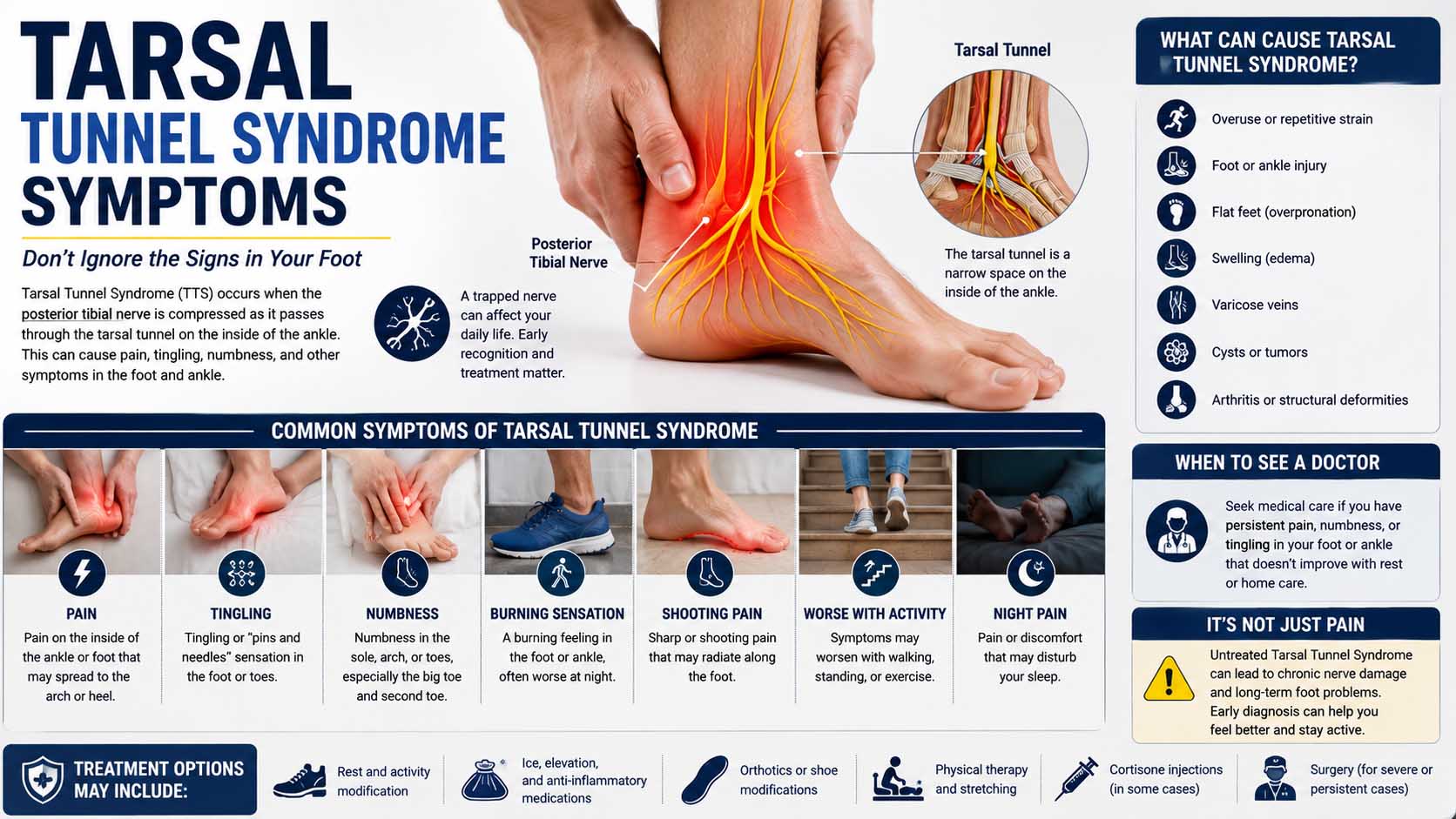
Burning, tingling, or numbness along the bottom of your foot can sometimes come from a compressed nerve near the ankle. Tarsal tunnel syndrome symptoms often affect the inner ankle, heel, arch, or sole and may become more noticeable after standing, walking, or exercising. Because these sensations can resemble several other foot and nerve problems, getting the right diagnosis matters, especially when symptoms persist or interfere with everyday activities.
What Is Tarsal Tunnel Syndrome?
Tarsal tunnel syndrome is a nerve compression condition involving the posterior tibial nerve or one of its branches. This nerve travels through a narrow passage called the tarsal tunnel, which sits along the inside of the ankle.
A strong band of tissue called the flexor retinaculum forms part of this tunnel. Meanwhile, several tendons, blood vessels, and the tibial nerve pass through the same limited space.
Therefore, swelling, injury, structural changes, or a mass within or around the tunnel can place pressure on the nerve. As a result, pain and unusual sensations may develop anywhere along the nerve’s distribution into the foot.
The condition is sometimes compared with carpal tunnel syndrome in the wrist because both involve nerve compression within a confined anatomical space. However, they affect different nerves and parts of the body.
Common Tarsal Tunnel Syndrome Symptoms
The symptoms of tarsal tunnel syndrome vary from person to person. Some people develop mild intermittent tingling, while others experience persistent burning pain or numbness.
Common symptoms include:
- Burning pain in the sole or inner ankle
- Tingling or “pins and needles”
- Numbness in parts of the foot
- Shooting or electric-like pain
- Discomfort extending into the heel or arch
- Increased symptoms after prolonged standing
- Unusual sensitivity to touch
- Occasional weakness involving small foot muscles in more advanced cases
Symptoms may affect only one foot, although some people experience problems in both feet.
Likewise, the exact location depends partly on which portion or branch of the tibial nerve is affected. Therefore, one person might mainly feel heel pain, while another notices burning across the sole or toes.
What Do the Symptoms Usually Feel Like?
People often describe nerve-related symptoms differently from ordinary muscle soreness. For example, the discomfort may feel hot, burning, electrical, prickling, or like small shocks.
In some cases, symptoms appear suddenly during activity. In others, they gradually become more frequent.
Meanwhile, nerve disorders elsewhere in the body can produce similar sensations. For example, charcot–marie–tooth disease symptoms can include weakness, sensory changes, and foot abnormalities, although Charcot-Marie-Tooth disease is an inherited peripheral nerve disorder rather than localized tibial nerve compression.
Because of this overlap, symptoms alone cannot reliably establish the diagnosis.
Where Are Tarsal Tunnel Symptoms Felt?
Tarsal tunnel discomfort typically starts around the inner ankle, near the path of the posterior tibial nerve. However, symptoms may travel into the heel, arch, sole, or toes.
Some people mainly notice symptoms while standing. Others feel discomfort after exercise or even while resting.
Meanwhile, tapping over the tibial nerve behind the inner ankle may reproduce tingling or an electric sensation in some people. Clinicians sometimes use this response, known as a Tinel sign, as one part of the physical examination.
Still, no single symptom or examination finding confirms tarsal tunnel syndrome by itself.
What Causes Pressure in the Tarsal Tunnel?
Several problems can narrow the tunnel or irritate the tibial nerve.
For instance, an ankle injury may lead to swelling around the nerve. Likewise, certain foot structures can alter pressure through the area.
Possible contributing factors include:
- Previous ankle injury
- Local swelling or inflammation
- Flat feet or certain foot mechanics
- Ganglion cysts
- Varicose veins around the tunnel
- Benign masses or other space-occupying lesions
- Arthritis or structural changes
- Repetitive stress on the ankle
- Systemic conditions that contribute to swelling or nerve problems
However, doctors cannot always identify one clear cause.
A bone spur on top of foot can also cause localized discomfort or irritation, but its location and mechanism generally differ from classic tarsal tunnel syndrome. Therefore, identifying exactly where the pain occurs can help narrow down possible causes.
Tarsal Tunnel Syndrome Symptoms and Treatment
Understanding tarsal tunnel syndrome symptoms and treatment starts with determining what is compressing or irritating the nerve. Treatment is not identical for every patient because the underlying cause, severity, and duration can differ.
Activity Modification and Rest
If repeated activity triggers symptoms, temporarily reducing the aggravating activity may help settle irritation.
For example, a runner may need to reduce mileage for a period rather than repeatedly exercising through increasing nerve pain. However, complete inactivity is not always necessary.
Instead, a healthcare professional or physical therapist can help determine which activities are appropriate.
Ice and Symptom Management
When swelling follows activity or injury, short periods of cold therapy may sometimes help with discomfort. However, avoid placing ice directly against bare skin, especially if you have reduced sensation in the foot.
Over-the-counter pain medicines may suit some people, although they do not remove the underlying nerve compression. Likewise, these medicines are not suitable for everyone. Therefore, people with other medical conditions or those taking medications should ask a healthcare professional or pharmacist when unsure.
Footwear and Orthotics
Supportive footwear can sometimes reduce mechanical stress on the ankle and foot.
Likewise, orthotics may help selected patients when foot mechanics contribute to symptoms. However, the best approach depends on individual anatomy, so simply buying an insert does not guarantee relief.
Physical Therapy
Physical therapy may focus on mobility, strength, movement mechanics, and strategies that reduce irritation around the nerve.
A therapist may also recommend specific nerve-gliding or stretching exercises when appropriate. However, you should not simply push through exercises that increase numbness, burning, or electrical pain.
How Doctors Diagnose Tarsal Tunnel Syndrome
Diagnosis usually starts with a medical history and physical examination. A clinician will ask where symptoms occur, what they feel like, when they started, and which activities make them better or worse.
The clinician may then check the foot and ankle for swelling, tenderness, structural differences, muscle weakness, and sensory changes.
In some situations, doctors use nerve conduction studies or electromyography to assess nerve function. However, clinicians need to interpret test results alongside symptoms and examination findings because no single test works perfectly for every case.
Imaging may also help when a clinician suspects a structural cause. For example, ultrasound or MRI can sometimes identify a cyst, mass, inflammation, or another problem near the nerve.
X-rays may help when bone or joint abnormalities are a concern.
For additional medical information about the condition, see Johns Hopkins Medicine’s overview of tarsal tunnel syndrome, which covers symptoms, causes, diagnosis, and treatment.
Conditions That Can Mimic Tarsal Tunnel Syndrome
Foot pain is extremely common, so several conditions can resemble tibial nerve compression.
Plantar fasciitis, for example, commonly causes heel pain. However, it usually produces a different symptom pattern and does not typically cause the same burning, tingling, or numbness associated with nerve irritation.
Other possibilities include:
- Peripheral neuropathy
- Lumbar nerve problems
- Plantar fasciitis
- Stress injuries
- Tendon problems
- Local nerve entrapment elsewhere in the foot
- Arthritis
- Certain systemic neurological conditions
For this reason, persistent numbness or burning deserves a proper evaluation rather than self-diagnosis based solely on symptom location.
Anterior Tarsal Tunnel Symptoms Are Different
Although the names sound similar, anterior tarsal tunnel syndrome involves compression of the deep peroneal nerve at the front of the ankle rather than the posterior tibial nerve behind the inner ankle.
Therefore, anterior tarsal tunnel syndrome symptoms tend to follow a different distribution.
A person may develop pain or tingling on the top of the foot, especially around the space between the first and second toes. Tight footwear or equipment pressing across the front of the ankle can sometimes contribute.
By comparison, classic posterior tarsal tunnel syndrome more often causes symptoms along the inner ankle and bottom of the foot.
Recognizing the difference helps, although a clinician should diagnose persistent nerve symptoms.
When Is Surgery Considered?
Many people start with nonsurgical treatment, especially when symptoms are mild and no urgent structural problem exists.
However, doctors may consider surgery when they identify significant nerve compression and conservative treatment does not provide enough improvement. Surgery may also be appropriate when a specific structure, such as a mass, clearly compresses the nerve.
Tarsal tunnel release surgery aims to create more room for the nerve by releasing the tissue that forms the roof of the tunnel. If another structure causes compression, the surgeon may address that problem as well.
Still, surgery is not automatically the best choice for every case. Results can depend on the cause, duration of nerve compression, diagnostic certainty, and other individual factors.
Recovery and Everyday Foot Care
Recovery depends heavily on the underlying problem and treatment. Mild irritation associated with temporary overuse may improve with activity modification and appropriate care, while long-standing nerve compression may take considerably longer.
If you need surgery, recovery is also gradual. A surgeon will provide instructions about wound care, weight-bearing, footwear, activity, and rehabilitation.
Meanwhile, maintaining comfortable footwear and avoiding repeated pressure over an irritated nerve can be sensible.
Some people also investigate topical approaches and the benefits of magnesium oil on feet for foot discomfort. However, magnesium applied to the skin has not been established as a treatment for tarsal tunnel nerve compression, so it should not replace diagnosis or evidence-based care.
Can You Reduce the Risk?
Not every case is preventable. For example, a cyst or another structural problem may develop without an obvious preventable cause.
Still, reducing unnecessary strain may help protect overall foot and ankle health.
Wear shoes that fit correctly, increase exercise intensity gradually, and allow adequate recovery after demanding activity. Likewise, seek care for persistent ankle injuries rather than repeatedly exercising through worsening symptoms.
People with diabetes or other conditions that can affect peripheral nerves should also follow their recommended medical care and regularly pay attention to changes in foot sensation.
Symptoms That Need Medical Attention
Occasional mild foot tingling after sitting awkwardly may disappear quickly. However, recurring or persistent symptoms deserve more attention.
Arrange a medical evaluation if you experience ongoing numbness, burning, tingling, or shooting pain in the foot, especially when symptoms get worse or limit walking and exercise.
Likewise, seek care if you notice progressive weakness, significant loss of sensation, or symptoms following a substantial ankle injury.
Sudden severe symptoms, inability to bear weight, major swelling, a cold or unusually pale foot, or rapidly developing neurological changes may require more urgent assessment.
Frequently Asked Questions
Does Tarsal Tunnel Syndrome Cause Heel Pain?
Yes, it can. Because branches of the tibial nerve supply parts of the heel and sole, some people experience heel discomfort. However, heel pain has many other possible causes, including plantar fasciitis.
Is Tarsal Tunnel Pain Worse at Night?
It can be. Some people notice burning or tingling while resting or at night, while others mainly experience symptoms during prolonged standing, walking, or exercise.
Can Tarsal Tunnel Syndrome Cause Numb Toes?
Yes. Depending on which nerve branches are affected, altered sensation may extend toward parts of the sole and toes. However, toe numbness can also result from other nerve conditions.
Does Tarsal Tunnel Syndrome Go Away on Its Own?
Mild symptoms related to temporary irritation may improve, especially when you address the trigger. However, persistent nerve compression may require treatment. Therefore, do not simply ignore ongoing numbness or worsening symptoms.
How Can I Tell if My Foot Pain Is Nerve-Related?
Burning, tingling, electric-shock sensations, or numbness can suggest nerve involvement. Still, those features do not identify the exact cause. A clinical examination can help distinguish tarsal tunnel syndrome from other foot, ankle, and neurological conditions.
Practical Next Steps for Persistent Foot Symptoms
Tarsal tunnel syndrome symptoms often have a nerve-like quality, particularly burning, tingling, shooting pain, or numbness around the inner ankle and bottom of the foot. However, several other conditions can produce similar complaints, so symptom matching alone is not enough for a reliable diagnosis.
For mild symptoms, reducing aggravating activity and checking footwear may be reasonable first steps. However, a qualified healthcare professional should assess persistent numbness, worsening pain, weakness, or recurring symptoms. Identifying the actual source of nerve irritation gives you a much better chance of choosing treatment that addresses the problem rather than simply masking the discomfort